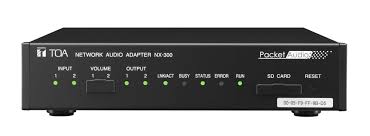
Network Audio Adaptar- NX-300
The NX-300 Network Audio Adapter is an audio interface device that allows you to integrate analog audio sources into a digital IP-based network audio system. It is typically used in environments where you need to connect traditional audio equipment or legacy systems with modern IP-based audio networks, facilitating seamless communication across a variety of devices.
The NX-300 can play a crucial role in converting and transmitting audio signals from non-IP devices (like microphones, amplifiers, and speakers) into digital data that can be distributed over an IP network to other networked audio devices. This makes it an important component for upgrading existing systems to be compatible with newer, more flexible IP-based systems.
Products Focus:
,Network Audio Adaptar- NX-300
Key Features and Functions of the NX-300 Network Audio Adapter:
Analog to IP Conversion:
The NX-300 serves as a bridge between analog audio sources (e.g., traditional microphones, audio mixers, or speakers) and digital network audio systems. It converts the analog audio signals into a digital format suitable for IP transmission, enabling integration with IP-based voice evacuation, public address (PA), or intercom systems.
High-Quality Audio Transmission:
It is designed to ensure high-quality audio transmission across the IP network, minimizing signal degradation or distortion, which is critical for applications like emergency communication or live public address systems.
Supports wideband audio codecs for clear, intelligible sound even in noisy environments.
Network Compatibility:
The NX-300 connects to the IP network via Ethernet (often supporting both standard Ethernet and PoE, Power over Ethernet). This ensures that it can be easily integrated into any existing network infrastructure.
It supports industry-standard protocols like RTP (Real-time Transport Protocol) or VoIP (Voice over IP) for seamless audio streaming.
Audio Input/Output Options:
The device may feature multiple audio input and output ports, allowing you to connect various audio sources or endpoint devices (such as speakers or microphones). This flexibility is useful when integrating traditional equipment into an IP-based system.
Flexible Configuration:
The NX-300 often allows for flexible configuration options, such as adjusting audio levels, setting priorities for certain messages (e.g., overriding background music with emergency announcements), or choosing specific audio channels for different zones or areas.
Many adapters also offer features like signal routing, so you can route audio to specific networked endpoints, amplifiers, or speakers.
Centralized Monitoring and Control:
The NX-300 is often part of a larger networked audio system, which can be centrally monitored and controlled via software. This makes it easier for operators to manage all connected devices, check system status, and troubleshoot any issues remotely.
It may also provide diagnostic information, such as signal strength or health of the connected devices, helping to maintain system integrity.
Failover/Redundancy:
In critical environments, such as public safety or industrial settings, the NX-300 may include failover or redundancy features, ensuring that the system continues to operate in case of network failure or hardware malfunction.
Scalability:
Since it operates over an IP network, the NX-300 is highly scalable. You can add more devices as your system grows without the need to lay new audio cables, as long as the devices are connected to the same network.
This makes it suitable for a wide range of environments, from small buildings to large campuses or facilities.
Interoperability:
The NX-300 is often designed to work with other networked audio components, such as IP speakers, amplifiers, microphones, and control panels, providing a fully integrated solution for voice evacuation or public address systems.
It can be used in conjunction with various brands or platforms, offering flexibility when choosing components for your system.